

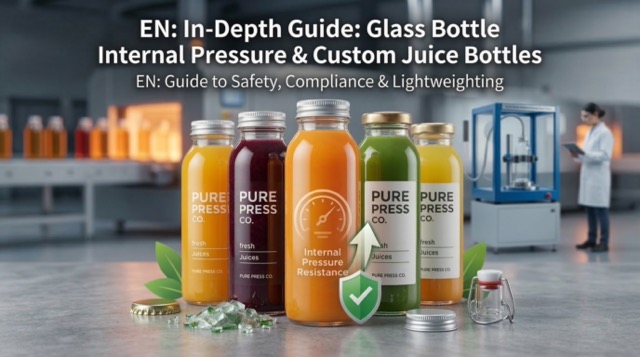
When sourcing glass packaging for beverage brands, safety is always the primary concern. For juice brands, a high-quality juice bottle must not only look appealing but also possess sufficient physical strength to withstand production, transportation, and storage challenges. Among these metrics, a glass bottle’s internal pressure resistance is a core indicator of quality.
What is Internal Pressure Resistance?
Internal pressure resistance generally refers to the maximum outward expansion pressure from internal liquids or gases that a glass container can withstand without breaking. In the industry, this is usually measured through destructive hydrostatic testing (burst testing) using a Burst tester, with units typically in Megapascals (MPa) or Bar. High internal pressure resistance effectively prevents explosions during filling, pasteurization, and consumer opening, safeguarding production safety.
Why Do Juice Bottles Specifically Need High Internal Pressure Resistance?
Compared to standard still water or liquor bottles, juice filling environments demand a higher pressure-resistance capacity:
Hot Filling and Pasteurization
To extend shelf life, many juices utilize hot filling or pasteurization. The liquid expands due to heat; if the bottle lacks adequate internal pressure resistance or undergoes drastic temperature changes (thermal shock), it is prone to bursting.
Fermentation and Gas Expansion
Cold-pressed juices or Kombucha can undergo slight fermentation if the cold chain breaks, generating CO2. Carbonated juice drinks also inherently contain high-pressure gas. The immense internal pressure created directly dictates packaging safety.
Factors Affecting Bottle Strength and the Future of Green Manufacturing
A bottle’s internal pressure resistance is affected by shape design (cylindrical is best), wall thickness uniformity, and annealing processes. Notably, under global decarbonization trends, enhancing glass strength while reducing carbon emissions has become the new industry standard.
Industry Trend: Europe’s “Furnace for the Future” Project
FEVE is advancing hybrid furnace technology using 80% renewable electricity and 20% gas.
dvanced electric furnaces reduce the carbon footprint and offer precise temperature control, improving glass uniformity and internal pressure performance.
ESG-focused brands should prioritize suppliers using low-carbon furnaces and efficient annealing processes. (Source: British Glass) Furnace for the Future project
Export Compliance: Balancing Strength and Lightweight Packaging
If your juice brand plans to export to the EU, merely ensuring “the bottle doesn’t burst” is no longer enough. Current policies require brands to minimize packaging material (glass lightweighting) while maintaining internal pressure standards. This heavily tests a factory’s 3D stress modeling and blowing techniques.
Policy Update: EU PPWR
Summary:The EU PPWR entered into force in Feb 2025, mandating all packaging to be recyclable and reducing virgin material use by 2030.
Impact:Exported glass juice bottles face strict “over-packaging” reviews; brands must advance lightweight designs while maintaining high pressure resistance.
Actionable Advice:Brands should immediately discuss with manufacturers how to optimize bottle thickness without compromising burst strength. (Source: European Commission) Packaging waste – Environment
Procurement Trend: EU Green Public Procurement
Summary:Based on PPWR, the EU is setting mandatory Green Public Procurement (GPP) minimum requirements.
Impact:Beverage suppliers in government supply chains must use glass bottles with higher cullet (recycled glass) inclusion rates.
Actionable Advice:Verify the recycled cullet percentage with glass factories during inquiries to meet future green procurement thresholds.
Custom Juice Glass Bottle Selection & Comparison Table
To help procurement managers make better choices, below is a process comparison:
| Parameter/Feature | Standard Juice Bottle – Non-carbonated | High-Pressure/Heat-Resistant – Carbonated/Hot-fill |
| Recommended Shape | Round, square | Cylindrical preferred,avoid sharp angles |
| Internal Pressure | Routine requirements | High, strict burst testing |
| Thermal Shock | Moderate, ~30-40°C diff | Extremely high, for pasteurization |
| Suitable Closures | Aluminum screw caps | Crown caps, thick screw caps |
FAQ
How much internal pressure can a standard glass juice bottle hold?
Standard juice bottles can typically withstand 1-3 bar. For custom carbonated juice bottles, we increase the resistance to 6-10 bar or higher, depending on the carbonation volume.
Does a heavier bottle mean better internal pressure resistance?
Not necessarily. While thickness helps, “even glass material distribution” is far more critical than simply adding weight. Uneven thickness makes the bottle more prone to bursting, which is why proper lightweighting can remain highly safe.
Inquiry Checklist Reminder:
For efficient quotation, please provide: Juice type (carbonated/hot-fill?), capacity, estimated MOQ, and whether closures are required.