

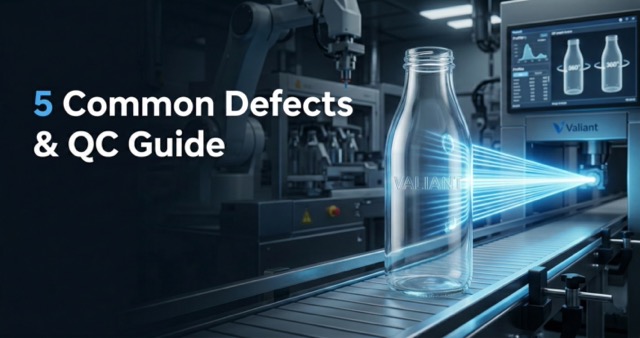
In the modern packaging industry, sustainability is a regulatory and consumer mandate. According to the Glass Packaging Institute (GPI), the demand for sustainable, returnable glass bottles is experiencing a significant resurgence, particularly in the dairy sector for local milk delivery.
However, returnable glass bottles must withstand rigorous washing, high-temperature pasteurization, and the physical bumps of local delivery routes. To ensure safety, rigorous QC inspection is non-negotiable.
1.Blisters and Bubbles (The Hidden Weakness)
Blisters are trapped gas bubbles inside the glass matrix. While a tiny bubble might seem harmless, excessive blisters compromise the structural integrity. They typically occur due to improper melting temperatures in the furnace.
In returnable glass milk bottles, blisters create weak points that can burst under the high pressure of industrial washing or sudden temperature changes. Advanced camera systems are used during QC to detect the size and cluster density of bubbles.
2.Checks and Tears (The Fracture Risk)
Checks are microscopic surface cracks that do not penetrate entirely through the glass. These defects are usually the result of thermal shock (cooling the glass too quickly) or mechanical damage. Checks are incredibly dangerous because they are not always visible.
During local delivery, a slight impact can cause a “checked” bottle to shatter. Automated optical inspection (AOI) machines shine high-intensity beams to catch the reflections of these micro-cracks.
3.Uneven Wall Thickness (The Durability Killer)
A high-quality glass bottle should have a uniform wall thickness. Uneven glass distribution often stems from improper mold alignment or incorrect timing in the forming processes. A bottle with uneven walls is highly susceptible to breakage, as thin sections cannot withstand capping machines or milk crate transport. Quality control utilizes ultrasonic thickness gauges to measure glass distribution and reject faulty bottles.
4.Stones and Inclusions (The Structural Flaw)
Stones are small, solid, non-glass inclusions embedded within the bottle wall, often un-melted batch materials. Stones have a different coefficient of thermal expansion than the surrounding glass. When hot milk is filled into a cold bottle, the glass and the stone expand at different rates, causing a spontaneous fracture. High-resolution optical scanners are highly effective at spotting these opaque inclusions against the transparent glass.
5.Finish Defects (The Sealing Saboteur)
The “finish” is the top part of the bottle—the lip and threads. Defects here include chipped lips or uneven threads, caused by wear and tear on molds. For dairy products, a finish defect prevents the cap from sitting flush, allowing oxygen and bacteria to enter, leading to milk spoilage and leaks. Specialized profile cameras capture a 360-degree view of the bottle neck to ensure perfect sealing surfaces.
The Role of Advanced QC Inspection
Continuous, inline QC inspection guarantees product safety.
State-of-the-art facilities utilize Automated Optical Inspection (AOI) to scan hundreds of bottles per minute, squeeze testers for structural integrity, and bore gauges for inside diameter accuracy.
By eliminating glass bottle defects, manufacturers protect the end-consumer and ensure returnable bottles complete their lifecycle safely.
Trust in Quality with Valiant
At Valiant, our glass bottles undergo rigorous, multi-stage QC inspection processes to eliminate defects—ensuring every bottle is safe, durable, and ready for your local delivery or wholesale needs. Choose reliability.
Choose Valiant.
FAQ
Q: What is the most dangerous glass bottle defect?
A: Checks and stones. Checks cause breakage under slight pressure, while stones cause spontaneous breakage during temperature changes (thermal shock).
Q: Can defective glass bottles be recycled?
A: Yes! Defective bottles caught during QC are crushed into “cullet” and melted down to make new bottles.
Ready to upgrade your packaging?
[Contact Valiant today] for defect-free glass bottles!