

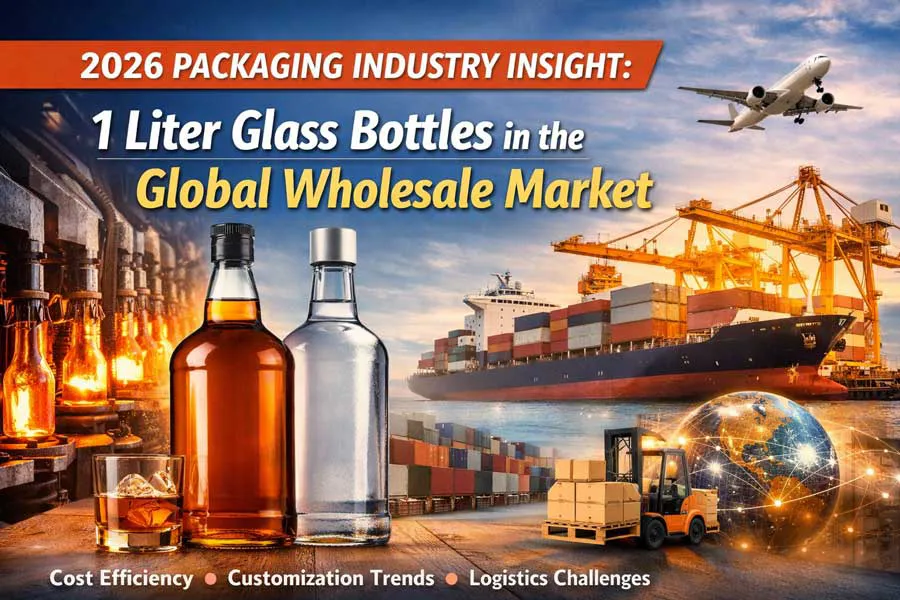
In the global spirits and beverage industry, packaging formats are quietly evolving.
Beyond the traditional 750ml standard, 1 liter glass bottles (also referred to as 1000ml glass bottles or 1 liter liquor bottles) are gaining wider acceptance across multiple markets, particularly in whisky, vodka, flavored spirits, and foodservice-exclusive products.
Industry feedback and trade data suggest that as 2026 approaches, large-format standardized packaging is delivering measurable advantages in cost efficiency, channel adaptability, and shelf presence.
This article provides an industry-focused analysis of the wholesale 1 liter glass bottle market, covering market drivers, technical specifications, and supply chain risk considerations.
Why the Global Market Is Paying Renewed Attention to 1 Liter Glass Bottles
Reassessing Cost Efficiency per Unit Volume
As raw material prices, labor costs, and international freight rates continue to fluctuate, distilleries and brand owners are reassessing how packaging structure impacts overall cost control.
Compared with standard 750ml glass bottles, 1 liter glass bottles offer a lower packaging cost per milliliter.
In filling, labeling, and case packing operations, processing a single 1 liter bottle is often more efficient than handling multiple smaller formats. This volume efficiency becomes especially relevant in B2B wholesale programs and long-term export contracts.
For brands operating at scale, the cost advantage compounds over annual procurement cycles.
Shelf Presence and Brand Differentiation
In retail, duty-free, and on-trade environments, 1 liter glass bottles naturally command more visual attention due to their height and weight.
An increasing number of emerging spirit brands are adopting the 1 liter format as either a supplementary or strategic SKU, particularly for family-size, sharing-oriented, or hospitality-focused product lines.
Market observations indicate that shoulder design, bottle proportions, and perceived glass weight play a critical role in consumer acceptance at the point of sale.
Technical Specifications That Define 1 Liter Glass Bottle Performance
Due to increased capacity and physical weight, 1 liter glass bottles place higher demands on manufacturing precision and quality control.
Glass Material Options
The most commonly used glass materials for 1 liter bottles include the following.
Super flint glass offers exceptional clarity and minimal impurities, making it suitable for vodka, tequila, and other spirits where liquid transparency is a key visual element.
High flint glass provides a balance between clarity and cost efficiency and is widely used in large-volume export programs.
Colored glass, such as amber or green, offers effective light protection and is often selected for light-sensitive spirits or functional beverages.
Structural Stability and Manufacturing Tolerances
On high-speed filling and automated labeling lines, structural consistency is essential for 1 liter glass bottles.
Key considerations include vertical axis alignment, uniform wall thickness, and thermal shock resistance.
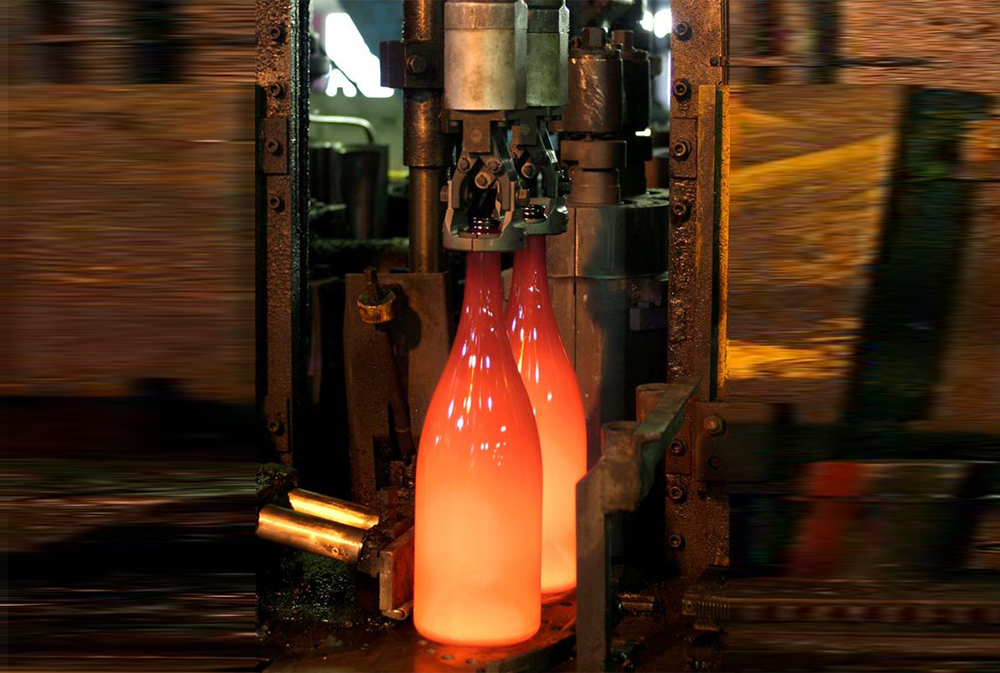
Industry experience consistently shows that bottles produced on fully automated IS machines achieve superior dimensional consistency, reducing downstream production disruptions and transportation losses.
Finish and Closure Compatibility
Bottle finish design directly affects sealing performance and closure supply chain compatibility.
Common finish types for 1 liter glass bottles include the following.
GPI or standard screw finishes are widely used in retail applications due to ease of opening and reliable sealing.
RoPP finishes are the global standard for spirits, offering tamper evidence and consistent sealing performance.
Cork finishes are typically used for products emphasizing heritage, craftsmanship, or premium positioning.
Customization Trends Driving Differentiation in 1 Liter Glass Bottles
As market competition intensifies, brand owners are increasingly leveraging glass bottle customization to stand out.
Unlike label-only differentiation, glass-based decoration provides stronger brand recognition and inherent anti-counterfeiting benefits.
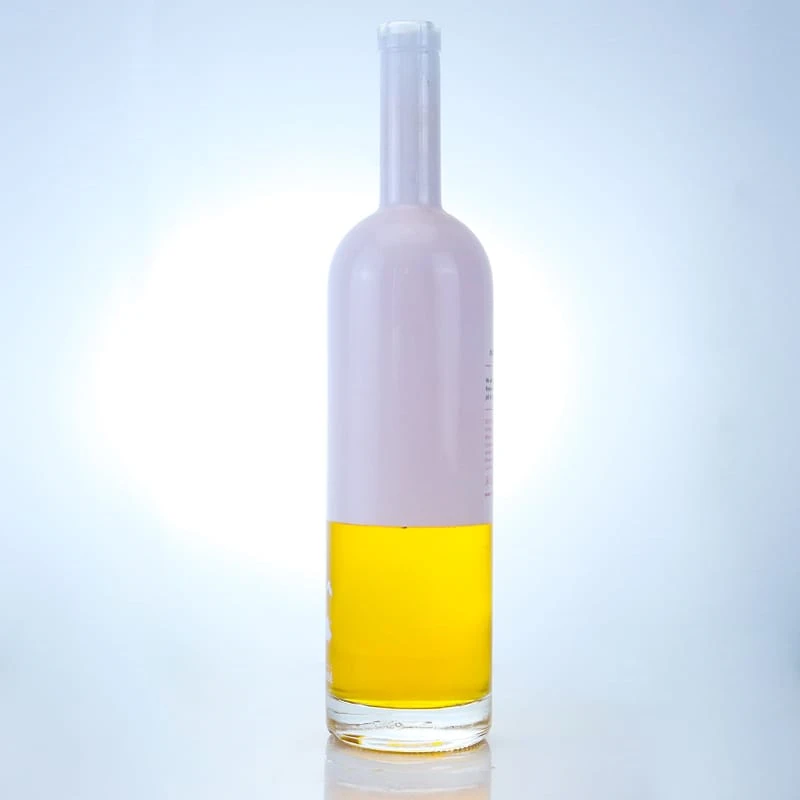
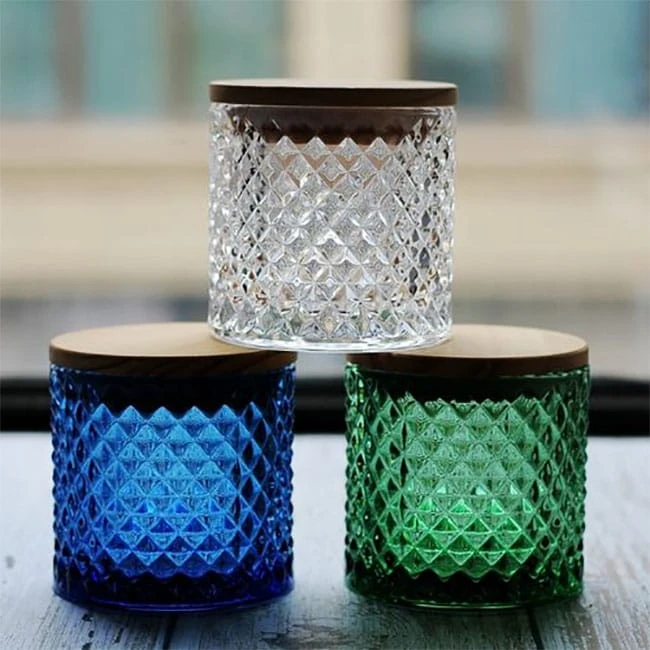
Popular customization approaches include embossed logos, debossed elements, frosted finishes, silk-screen printing, and gradient spray coatings.
From a wholesale perspective, light customization based on existing bottle molds is emerging as the most cost-effective strategy.
Logistics and Risk Management in Wholesale Procurement
Because of their size and weight, 1 liter glass bottles carry higher logistics costs compared with smaller formats.
Common Packaging Methods
Palletized packaging is preferred for full-container shipments and automated warehouse systems.
Divided carton packaging offers greater flexibility and is commonly used for multi-destination or distributor-level shipments.
Breakage Rates and Contract Considerations
Within the glass packaging industry, a transportation breakage rate below 3 per thousand is generally considered acceptable.
Wholesale buyers are advised to clearly define loading methods, damage assessment criteria, and compensation mechanisms within procurement contracts to minimize risk exposure.
Frequently Asked Questions About Wholesale 1 Liter Glass Bottles
What is the typical MOQ for 1 liter glass bottles?
For standard stock bottles, minimum order quantities typically range from 10,000 to 20,000 units.
For fully customized molds, MOQs generally start at 30,000 units or higher.
How can buyers verify food-contact safety compliance?
Suppliers should be able to provide SGS, FDA, or relevant EU food-contact compliance reports, with particular attention to heavy metal migration limits.
Are 1 liter glass bottles suitable for carbonated beverages?
Standard 1 liter spirit bottles are not designed for carbonated products.
Carbonated beverages require pressure-rated glass bottles specifically engineered to withstand internal pressure.
Industry Outlook for 2026
Based on market trends and production data, 1 liter glass bottles are transitioning from a supplementary format to a strategic packaging option for many brands.
For companies serving export, hospitality, or wholesale channels, the 1 liter format is expected to maintain steady relevance through 2026.
Success depends on aligning bottle specifications with target markets, managing logistics risks effectively, and using design and decoration to achieve meaningful differentiation.